This webinar was recorded on July 1, 2026
About the Webinar
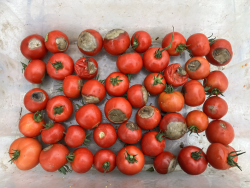 Dry-farmed tomatoes are emerging as a popular crop in the western US. However, blemishes related to drought stress, especially blossom-end rot (BER), can be a major issue in their production. Farms vary considerably in their BER incidence; on some farms no fruits are affected, on others BER can affect up to 90% of the fruit. In 2023, the OSU Dry Farming Program initiated the BER Toolkit Project, to develop methods for farmers to control BER and other blemishes for dry-farmed tomato production. Methods tested included grafting, intercropping with sorghum, amendment applications, planting density, trellising, and pre-stressing the crops in the nursery prior to planting. Researchers found that some of the methods, like grafting and limiting fertilizer applications, resulted in reductions in drought stress and BER. However, these methods also reduced the flavor intensity of the fruit.
About the Presenter
Matthew Davis is a fourth-generation Oregon dry farmer (walnuts and prunes) and a faculty research assistant at Oregon State University. Matthew began his career in farming in 2004, lifting catch wires and training grape vines at a vineyard in southern Oregon. He has also worked as a farm laborer in walnuts, Christmas trees, and nursery crops. He received a B.S. in Biology at University of Oregon in 2012 and a M.S. in Sustainable Forest Management at Oregon State University in 2018. He started working on dry farming research in 2019 with Dr. Alex Stone. He is the author of seven peer-reviewed articles and extension publications on dry-farmed vegetable production.